The Marble Forest: The Temple of Artemis and the Architecture of Awe
Monolithic systems are like the great temples of antiquity: unified works of precision and ambition that, in the face of time and shifting trends, compel us to reappraise the imprint of awe.
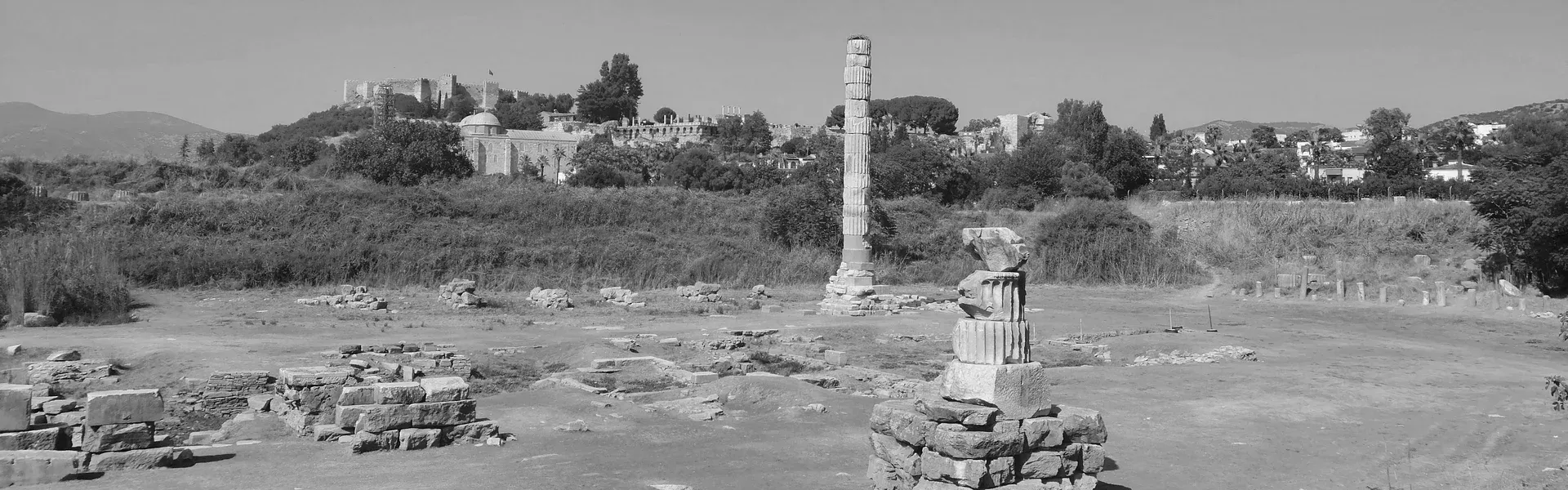
There was a time when architecture sought not merely usefulness, but divinity. The Temple of Artemis at Ephesus, one of the Seven Wonders of the Ancient World, was the absolute triumph of that idea. Imagine a structure built almost entirely —99%— of the purest white marble. Under the Mediterranean sun, the temple did not merely reflect light; it seemed to generate it. Those who approached described an almost divine effect, a blinding radiance that made the 127 columns, each twenty meters tall, look like a petrified forest of light.
What raised it to the rank of “wonder” was not only its colossal scale, but that it was art within art. These were not smooth, mute pillars. At their base, the columns bore engravings and reliefs sculpted by the greatest masters of the age, such as Scopas. Every square centimeter was charged with narrative, with technical and aesthetic details that made the overall structure merely the canvas for thousands of micro-stories carved in stone. It was a work in which architecture and sculpture fused indivisibly.
The Monolith: The Temple We Inhabit
This image of the “marble forest” is the perfect mirror for the great monolithic projects that defined the first golden ages of software. Like the temple at Ephesus, these systems were massive, coherent, and dazzling structures. They were the place where millions of users placed their trust and their daily lives.
A well-built monolith (think of the original architectures of giants like Amazon, or the early kernels of operating systems) was not merely “a block of code.” It was a cathedral of logic where every function and every module was engraved with precision to fit into a harmonious whole. There was a beauty in that centralization: you knew where you stood, you felt the solidity of the foundations and the radiance of a unified vision. It was the art of engineering in its purest and most ambitious state.
The Quarry and the Oblivion
The Temple of Artemis survived fires and pillaging, but it did not survive neglect. As the era and the way of thinking changed, people stopped seeing it as a sacred place. They began to see it as a quarry. What had once been a sacred relief at the base of a column ended up as a step in a church or as reinforcement in a retaining wall. Art was fragmented by the utility of the moment.
In the world of technology, we have lived through this dismantling. Modernity and its trends led us down the path of microservices. Like the inhabitants of Ephesus, we took the logic of those great monolithic temples and broke it into pieces. We fragmented the unified vision into thousands of small, independent parts. While we gained agility, we often lost the sense of the complete work. Today, many of those systems “shine” less because they are scattered; they are functional, but they have lost the aura of wonder that only the integrity of a great work can confer.
Is AI the New Temple of Ephesus?
Now, we stand before a new work that seems to defy human scale: Artificial Intelligence. We are at that moment in history where the marble is being polished and the columns of parameters are being raised.
AI is today that forest of columns that amazes and frightens us at once. It is our new center of knowledge, our data bank, and our refuge of answers. But the story of Artemis leaves us a philosophical warning: human thought is cyclical. What seems to us today an unsurpassable wonder could tomorrow be regarded as a “pagan” or obsolete technology, whose pieces will be taken to feed the next great idea we cannot yet comprehend.
The Melancholy of Greatness
The painter Hubert Robert, nicknamed “the painter of ruins,” captured this feeling better than anyone. His paintings show glorious architectures being devoured by time, reminding us that even the most solid thing is ephemeral once human interest withdraws.
As architects —whether of stone or of software—, our mission is not only to build something that works today. It is to create works that, even when dismantled by time or trends, leave remains so beautiful and so masterfully engraved that future generations will pause before a single “column” of our code and be able to imagine the glory of the temple it once was.
The Temple of Artemis is remembered not for what remains of it, but for the magnitude of the awe it was able to sow in the collective memory. That is the true measure of success: not permanence, but the imprint of awe.