The AI and the Era of the New Enlightened
Part I of a series to demystify Artificial Intelligence: from the Oracle of Delphi to language models, the difference between deterministic and probabilistic systems, and why we mistake statistical coherence for human understanding.
Demystifying Artificial Intelligence — Part I
Every era builds its own mysteries. Not as a mistake, but as a necessity. When the world does not let itself be explained with ease, human beings do not always insist on understanding it; sometimes they prefer to inhabit it through narratives that make it bearable, even fascinating.
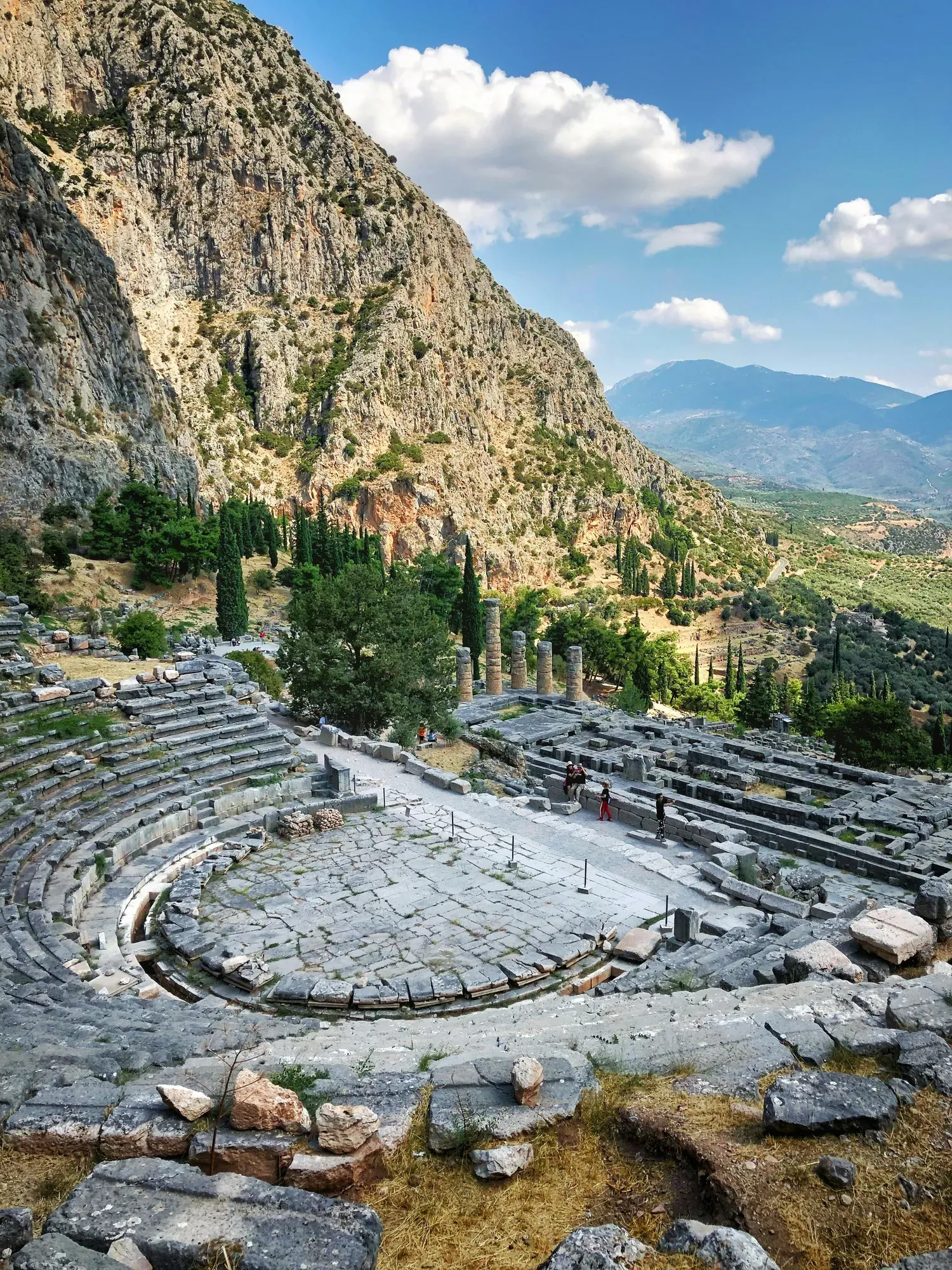
In ancient Greece, the Oracle of Delphi occupied that intermediate place between knowledge and uncertainty. Kings, generals, and merchants traveled long distances to hear answers that did not explain the world but reorganized it into the shape of destiny. What was interesting was not only the belief in the divine, but the very structure of the answers: ambiguous enough to survive any later interpretation, precise enough to feel revelatory in the moment. Over time, the distance between interpretation and truth ceased to be evident.
It is not hard to recognize something of that mechanism in the present. We have not abandoned Delphi; we have simply changed the device of consultation. We no longer walk toward a temple, but we still seek answers in systems we do not always fully understand. And in that silent transit, the figure of the oracle reappears disguised as technology.
Artificial Intelligence occupies that ambiguous space today. Not because it is mystical, but because our way of looking at it still is, in part. The tendency to attribute understanding where there is complexity is ancient, and AI, with its ability to produce coherent language, revives that almost instinctive inclination.
To begin undoing that mirage, it is necessary to dwell on a distinction that is often lost in public conversation: the difference between deterministic systems and probabilistic systems. This is not merely a technical difference, but a difference in the way we understand the relationship between cause, structure, and result.
For centuries, Western thought was comfortable with the idea of determinism. The universe as an ordered machine where every effect has a clear cause, and where knowledge consists in deciphering that mechanism. If the initial conditions and the rules of the system are known, the result is not a surprise but a consequence. A stone falls, a gear turns, a sum always produces the same value. In that world, uncertainty is not a property of the system but a limitation of the observer.
Traditional programming inherited that same sensibility. A function is a promise: same inputs, same outputs. Its behavior does not depend on interpretations or invisible contexts, but on explicit rules. The system does not “decide”; it executes. It does not “interpret”; it applies. And within that framework, the digital world seems a natural extension of deterministic logic.
That is why it is so easy to assume that a modern Artificial Intelligence works under the same logic. After all, it too is software, it too runs on machines, it too produces results from inputs. But that is where the confusion begins.
Today’s language models do not operate as deterministic systems, but as probabilistic systems. And that difference completely changes the nature of what we are observing.
To approach that idea, it helps to step away from the technical terrain for a moment and enter another language: that of painting. For centuries, academic painting sought to represent the world faithfully. Each element had a precise location within the artist’s intention. Each shadow obeyed a decision. Each figure responded to a prior design. There was a clear correspondence between will and result. The painting was, in a sense, the record of a plan.
But when we look at the Impressionists, that clarity becomes less evident. Up close, the canvas contains no defined objects, but fragments: patches, strokes, approximations. Nothing seems complete in itself. And yet, as one steps back, the whole takes on form. The landscape emerges not from individual precision, but from the accumulation of visual probabilities that the eye interprets as coherence.
Modern AI comes closer to that second type of construction than to the first. It does not compose answers from explicit rules that determine each word, but from estimates of which sequences are most probable given millions of prior examples. It does not “choose” in the human sense of the term; it calculates possible continuations within a learned statistical space.
Here a frequent misunderstanding appears. To say that something is probabilistic is not to say that it is random. Randomness implies the absence of structure. Probability, on the other hand, arises precisely from the structure accumulated in large volumes of data. It is not the absence of pattern, but the presence of too many overlapping patterns to reduce them to a single deterministic rule.
The difference is crucial. A deterministic system does not doubt: it produces a result because it is defined in advance. A probabilistic system does not “know” the result, but neither does it improvise it; it estimates it from deep regularities in the data. One responds from the rule. The other responds from the distribution.
And when that distinction is lost, the interpretation of the phenomenon changes entirely. We tend to observe the coherence of an answer and assume the existence of an understanding equivalent to the human one. We tend to see continuity in language and presume intention behind it. We tend, in other words, to apply a deterministic reading to a system that is not.
The result is a kind of conceptual fog. And that fog is the terrain where modern myths about Artificial Intelligence flourish: the idea that it thinks, that it understands, that it “knows” in the same sense a person does.
And yet, when we look more precisely, the fog begins to dissipate. Not because the system loses complexity, but because the way we look at it changes. What once seemed intention begins to seem structure. What seemed understanding begins to seem statistics at scale. What seemed an oracle begins to seem a mechanism.
And even so, the wonder does not diminish. It changes place.
Because what is truly interesting is not the idea of a machine that thinks like a human, but the emergence of systems capable of generating coherent language from pure accumulated probability. There is no magic here, but there is something that deserves attention: the emergence of behaviors that, observed from a certain distance, resemble intelligence without depending on it.
Perhaps that is the true lesson of this era. We have not built oracles. We have built statistical mirrors so complex that, when we look at them, we project onto them our own ways of understanding the world. And in doing so, we repeat an ancient story with a new language.
The difference is that now we can begin to see the mechanism behind the mirror. And when that happens, the mist does not vanish completely, but it does grow thin enough to make out the terrain.
And that terrain, far from being less fascinating, turns out to be wider than we imagined.
We are not facing an artificial mind. Nor a simple text generator. We are facing a probabilistic system that, at scale, produces effects that defy our most deeply rooted intuitions about what it means to “understand.”
And perhaps the first step to understanding it is not to attribute humanity to it, but to accept that complexity can also arise without intention.
In the next installment of this series we will explore another persistent myth of our age: the idea that Artificial Intelligence understands the meaning of words in the same way a human being does.