The Work and the Tool
Technique builds the craft, but no tool alone explains the totality of a work. A reflection on art, leadership, and software development.
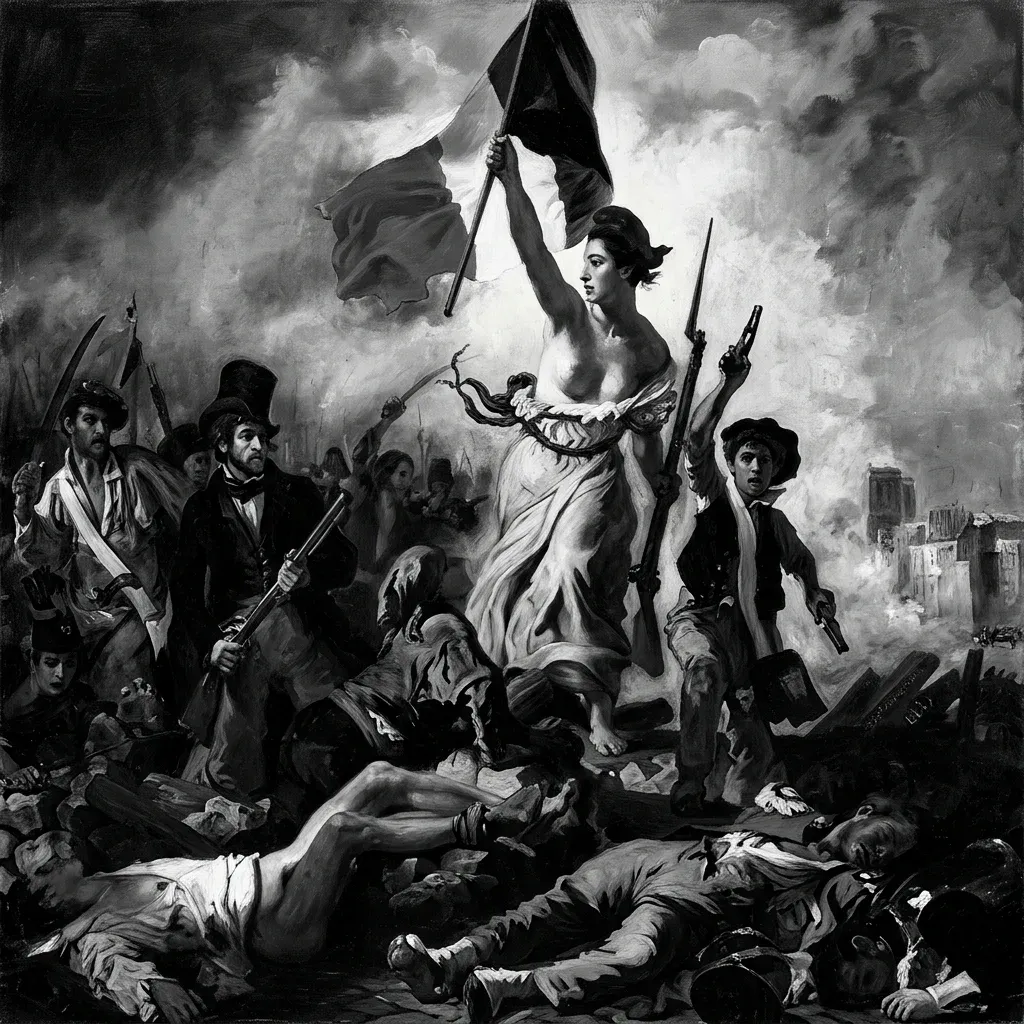
Ingres and Delacroix
At some point in nineteenth-century France, the salons of Paris began to divide around a debate that, seen from a distance, appears to be about painting, but that in reality addresses a far deeper question. The dispute pitted two of the most important artists of their time against each other: Jean-Auguste-Dominique Ingres and Eugène Delacroix. Both were admired, both were masters of their craft, and both devoted their lives to art. Yet they represented two distinct ways of understanding what it means to attain excellence.
Ingres had built his reputation on an almost obsessive discipline. His drawings were extraordinary. Every line seemed to occupy exactly the place that belonged to it, as if behind it lay an absolute command of anatomy, proportion, and composition. His contemporaries saw in him the culmination of an artistic tradition that had been perfecting itself for centuries. For many, to observe one of his works was to contemplate the evidence that talent, when combined with enough study and dedication, can come dangerously close to perfection.
It is difficult not to feel admiration for such a figure. After all, any serious discipline demands respect for the craft. No cathedral is built without understanding stone. No symphony can exist without years of practice. No complex system can hold together on foundations its creators do not understand. Technical excellence is neither an accident nor a privilege reserved for a chosen few. It is the result of a prolonged relationship with a tool, a relationship built through time, repetition, and constant learning.
For that reason, Ingres’s story is so interesting to those of us who work in technology. His pursuit recalls that of many developers who devote years to perfecting a language, an architecture, or a specific discipline. There is something profoundly noble in that dedication. Anyone who has invested thousands of hours in understanding the details of their craft ends up developing a sensibility that remains invisible to those who observe from the outside. Just as a painter distinguishes nuances imperceptible to most people, an experienced engineer can identify patterns, risks, and opportunities where others see only complexity.
Yet, while Ingres continued refining an already consolidated tradition, Delacroix began to draw attention for very different reasons.
History tends to present this kind of difference as a confrontation between technique and creativity, but that simplification is unfair to both artists. Delacroix also mastered drawing. He also understood composition. He too had devoted years to the rigorous study of painting. The difference lay not in the level of skill, but in the direction toward which he chose to orient that skill.
While Ingres seemed to ask himself how to perfect the act of drawing ever further, Delacroix seemed interested in discovering what he could communicate through his paintings. His works were full of movement, tension, and emotions that overflowed the limits of traditional academicism. He did not reject technique; he simply refused to turn it into the final destination of his work.
That difference may seem small, but it carries enormous implications.
Throughout history, many disciplines have gone through similar moments. As a craft matures, so too does the temptation to confuse mastery of the tools with an understanding of the problems those tools are trying to solve. It is an understandable phenomenon. Tools are tangible. They can be measured, compared, and perfected. It is far simpler to evaluate how well someone draws a human figure than to grasp the cultural impact of a complete work. In the same way, it is usually easier to measure command of a specific technology than to assess a person’s capacity to connect knowledge drawn from different areas.
Perhaps that is why the technology industry feels such a particular fascination with specialization. From our earliest years we learn to value technical depth. We learn languages, paradigms, architectures, methodologies, and tools of ever-increasing complexity. Each new piece of knowledge expands our capacity to build better, more robust, and more efficient systems. There is nothing wrong with that. In fact, a great deal of technological progress depends precisely on people who decide to devote years of their lives to understanding a problem with extraordinary depth.
Yet a moment arrives when the nature of the problems begins to change.
The most complex challenges rarely belong to a single discipline. They do not live solely in the code, nor in the infrastructure, nor in the data. They inhabit the spaces in between. They appear when technology meets the business, when architecture meets human behavior, or when technical decisions begin to produce organizational consequences that no diagram had foreseen.
It is at that point where the question ceases to be how much knowledge we are capable of accumulating and begins to transform into something else. The matter is no longer only about going deeper, but also about connecting. It is no longer merely about understanding a tool, but about understanding how that tool interacts with a far broader system.
We often think that technical leadership represents the natural culmination of specialization. We imagine that whoever leads a project must be the foremost expert in each of the domains involved in it. Yet experience tends to demonstrate something different. As organizations grow and problems become more complex, value ceases to be found exclusively in the ability to solve a specific task and begins to appear in the ability to understand how all those tasks relate to one another.
Great specialists remain indispensable. They are the ones who push the limits of knowledge within a particular domain. They are the ones who discover new solutions, refine processes, and build the components that make a larger work possible. But leadership requires a different perspective. It demands the ability to observe the whole without losing sight of the parts, to understand the context without disregarding the details, and to connect disciplines that, at first glance, seem to have no relation at all.
Perhaps that is why the analogies between development, art, and history have always interested me. Not because I believe that all disciplines are alike, but because they share surprisingly similar questions. A painting, a cathedral, a company, or a technological platform are, at their core, human attempts to organize complexity. And the more complex those systems become, the more evident it is that no tool, however powerful, can by itself explain the totality of the work.
The debate between Ingres and Delacroix remains relevant precisely because it was never solely about painting. What both artists represented were two distinct ways of growing within a discipline. One of them found meaning in the permanent pursuit of technical perfection. The other understood technique as a means to explore broader questions. Neither perspective was wrong. In fact, both are necessary.
After all, Delacroix could never have expanded the limits of painting without first mastering the tools of his craft. But neither would Ingres have reached such a level of excellence had there not existed, behind his work, a clear vision of what he considered valuable.
Perhaps the true lesson is not found in choosing between one or the other, but in understanding when each philosophy proves insufficient on its own. Every discipline needs specialists capable of going to extraordinary depths. But it also needs people capable of connecting that knowledge with something greater than themselves.
Because a perfectly mastered tool remains a tool.
And sooner or later every discipline ends up facing the same question that echoed through those Parisian salons nearly two centuries ago: if we devote an entire life to perfecting our instruments, will we also be capable of understanding the work they are trying to build?